2.3 Infinite Universe
A finite Universe can be thought as a confined space in which lay a finite number of galaxies as shown in Figure 2.6. It would be a collapsing Universe as the gravitational force of each galaxy attracts all other galaxies inwards towards a point which position depends on the distribution of the galaxies themselves.
However, an infinite Universe would have an infinite number of galaxies lying outside this border, each with a gravitational force attracting the galaxies inside the border outwards. Hence, when the galaxies are spaced apart enough, the resultant gravitational force for each galaxy inside the border would be outward, making the Universe "appear" expanding and accelerating outward.
For simplicity, consider an infinite array of galaxies, with equal mass, all spaced apart the same distance and arranged like a regular lattice (Figure 2.7). Each galaxy will experience the same gravitational attraction in all directions, in this way the Universe would be in static equilibrium. Now take one galaxy and displace it from one place to another leaving a hole one side, and filling a space another. We have now broken the equilibrium of our Universe, where we left the hole the galaxies will start expanding outward as their resultant force would not be balanced any more by the missing galaxy. On the other hand, that same galaxy that left the hole one side is now filling a space the other side, forming a cluster of galaxies which gravitational pull is inward towards the extra galaxy.
In math parlance let us consider the one dimensional version of the Universe as shown in Figure 2.8 below.
|
|

The figure shows an infinite line of galaxies all spaced equally from each other and having the same mass. Now, we know that the equation for the gravitational force acting on two isolated masses is:
|
|
(2.8) |

where r is the distance between each galaxy. Hence, the force acting on the galaxy placed at position zero along the infinite line towards the positive direction would be:
|
|
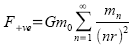
and the force acting in the negative direction would be:
|
|

which means that F+ve=F-ve and the galaxies are in equilibrium. However, if we take the galaxy at position -1 out of the line, then the two forces would be:
|
|

Therefore, F'+ve>F'-ve which means that m0 will experience a force towards the positive direction along the infinite line, and so do all other galaxies placed along the positive direction of the line. As far as the negative direction, it is simply a matter of applying the same reasoning to the galaxy placed at position -2 and so on. We will conclude that for m-2 the force pulling towards the negative direction is greater than the force acting towards the positive direction. That is same for all the galaxies placed along the negative direction, and extending it for all other dimensions of space you can see how the surrounding stars would be expanding when we are left with a hole and collapsing when we have an extra galaxy.
In conclusion, if the Universe is a random distribution of galaxies, than we would expect it to expand in some places and contract in others, so we were just lucky as it seems we ended up in an expanding zone.
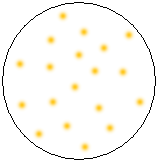
Figure 2.6 – Finite Universe

Figure 2.7 – Finite Universe
Figure 2.8 – Galaxies along an infinite line.