2.1.1 The assumption
Now let us discuss the assumption we made about the
limit of energy density that spacetime can take. To do
this we will look at the reason why waves propagate and
we will start from the easiest, that is a rope.
Everyone knows that if we start to oscillate one end of a
rope the waves propagate through the rope to reach the
other end which in turn oscillates in the same manner.
When we oscillate one end of the rope, all we do is to
oscillate around a middle point, and from there all other
points along the rope are pulled by the preceding point
and start to oscillate as well. Therefore there is an
interaction between all points along the rope, that makes
all points to oscillate around the same middle point.
The same observation can be done with water waves,
molecules of water, that cannot be pulled apart at liquid
temperature, pull other molecules to oscillates around a
middle point that is the level of the water in the tank
or the sea level if we are thinking at waves in the sea.
Now let us look at sound waves. Sound waves propagate
through a medium (let it be air)because molecules of air
are pushed and pulled by areas of high and low pressure.
Hence the pressure of a section area or shell inside the
wave oscillates around a value of pressure that stands in
the middle between the high and the low pressure.
In the same way, waves of electricity propagate through a
copper wire. Areas of high voltage with many electrons
push electrons towards areas of low voltage with very few
electrons and vice versa.
|
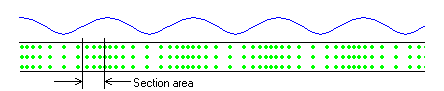
A small section area (or volume) inside the wire (see
Figure 2.3) will alternate moments of many electrons with
moments with few electrons, with a frequency equal to the
frequency of the traveling wave. The number of electrons
in the section area depends on the voltage applied to the
wire.
Therefore, in order to propagate, waves need a tendency
towards an average or middle value, or even better they
need some sort of potential/internal energy that is
stored in the medium they travel. This energy gets
released to the neighboring section areas making the wave
travel along the medium.
Electromagnetic waves behave in the same way, the only
difference is that each spherical shell or section area
vary in the intensity of electromagnetic field even if
they do not have a medium.
Many system have the natural tendency towards increasing
disorder, the measure of this disorder is called entropy.
Consider a thermally insulated box divided by a partition
into two compartments each having volume V (Figure 2.4).
Initially one compartment contains n moles of an
ideal gas at temperature T, and the other compartment is
evacuated. The system has the ability to do work, hence
has energy. We then break the partition, and the gas
expands to fill both compartments spreading like a sound
wave.
For this initial state the heat Q = 0, the work W = 0,
and the change in internal energy DU
= 0. Therefore, because it is an ideal gas DT = 0. In order to obtain an
isothermal expansion from V to 2V at temperature T, heat
must be supplied to keep the internal energy constant.
The gas does work during this substitute expansion, the
total heat supplied equals to the total work, which is:
|
(2.3) |

If we did not supply the system with heat, the final
state would have a lower internal energy than the initial
condition. So it seems that this tendency towards
"disorder" is in fact a tendency towards a
lower energy state of the whole system. All hot objects
tend to cool down eventually to 0°K if not heat is
supplied, and so is air pressure, it will tend to zero if
molecules are left free in space.
The system just described is not very different from the
section area described for sound and electric waves
above, hence waves need some sort of energy stored in the
medium in order to propagate. This energy gets released
as the system tends to go towards a more natural state or
"disorder". For an isolated systems the work
done during this process can be in the form of heat,
while for waves the work done on other particles (by
collision or repulsion/attraction) makes the wave travel
along the medium.
So it seems that in general free energy tends to zero and
if this was not the case, than waves would not propagate.
In conclusion, we can say that if energy in free
spacetime has the tendency to zero. As a consequence it
is not so crazy assume that spacetime must also have an
upper limit of energy density that it can take, otherwise
there would be no reason for this tendency to exist at
all.
In fact this would explain the repulsive and the
attractive force of molecular bonds. The attractive force
would be the electric force and the repulsive force would
be the limit of energy density that spacetime can take,
which behaves like a spring pushing outwards when two
atoms get too close.
Fig 2.3 - High frequency electric signal propagating through a copper wire. Single electrons oscillates around a fixed point. In the same way a section area along the wire will alternate moments of many and few electrons with the same frequency of the traveling wave.