1.2 Classical theory of
gravitational redshift
Gravitational redshift is the effect that gravity does on electromagnetic waves when entering or exiting a gravitational field. From Figure 1.1, it is possible to notice that the frequency is higher near the mass where the gravitational pull is stronger, and it is lower where away from the mass, where the pull is weaker. This can be shown by substituting the expression for the gravitational acceleration g into the formula for the gravitational redshift. This is:
 |
(1.0) |
The leftmost expression for the gravitational redshift, assumes that the signal is coming from outer space, therefore the redshift is taking place along the whole travelled distance or infinity. The rightmost expression, can be use to calculate the redshift of a signal transmitted at a certain height, by substituting the radius of the mass R with the travelled distance of the signal H. The formula can be derived imagining a photon of light falling on the mass. The mass of the photon is:
 |
(1.1) |
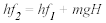
where the product h, the Planck's constant, and f, the frequency of the photon, represent the photon energy. When the photon falls for a distance H inside the gravitational field of the mass, it gains a potential energy equal to mgH. Thus, its total energy, at the end if its path is the sum of its initial energy and its final energy:
|
which, when inserting the photon mass (1.1) it becomes:
 |
(1.2) |
In the case of a signal coming from outer space instead, the derivation of the formula can be tackled using the potential energy of a mass on the surface of the Earth or any other large mass. That is:
 |
where M is the large mass and m is the smaller mass, which, when substituted with the photon mass (1.1) it becomes:
 |
Once again, the total energy of the photon is the sum of its original energy and the energy gained by the gravitational pull of the large mass:
 |
which is the same expression (1.0) but with a
minus sign in front which shows that the frequency
decreases as the signal leave the mass.
Experiments on testing the gravitational redshift on
Earth, was carried out by Robert V. Pound and Glen A.
Rebka in 1960 at Harvard University. They demonstrated
that a beam of very high energy gamma rays was slightly
redshifted when launched up the elevator shaft of the
Jefferson Tower physics building. The gamma ray was
emitted from the decay of a cobalt atom 57Co
to iron 57Fe at ground level with a frequency
3.5 x 10¹⁸ Hz. At the top of the 22.5m high
tower, the redshift can be calculated by using Equation
1.2, this results in about 8.6 kHz, which was measured
within 10%. [3]
In 1964-65 the experiment was reapeated by R. V. Pound
and J. L. Snider and proved within 1%. [4]
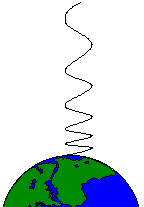 |
Figure 1.1 - Gravitational Redshift of a EM wave near a large mass.