1.3.2 Three dimensional spacetime model
The first step to deriving the distorted spacetime in
three dimensions is to start from its representation in
one dimension and try to develop it to the others two
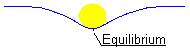
remaining. Figure 1.5a shows, the same rubber sheet model
shown in Figure 1.3 but with only one dimension. As
indicated, the figure suggests that at the middle, where
the slope of spacetime is horizontal, there is an
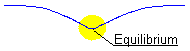
equilibrium point. Indeed, in real life, an equilibrium
point exists at the centre of every mass, therefore, the
drawing can be slightly improved if these two locations
are overlapped as shown in Figure 1.5b.
In order to visualise spacetime as a three dimensional
object, it is essential to immerse the mass into the
rubber sheet, since all masses are actually immersed into
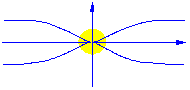
spacetime. The first step, is then to insert the model
into a coordinate system choosing the equilibrium point
as the origin as shown in Figure 1.5c. Bearing in mind
that the mass is buried into the spacetime medium, than
the same thing seen in one direction would be also seen
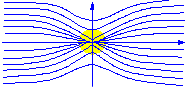
in all other directions. Starting with the horizontal,
the same line above is mirrored below the axis, again
shown in Figure 1.5c. Then, to better the idea of the
mass being plunged into the rubber sheet, a number of
layer, corresponding to distorted axis, can be added at
both the top and the bottom of the origin, considering
that the farther the layers are from the mass, the less
the distortion caused by the mass would be, up to a point
where the layer would be perfectly straight again (Figure
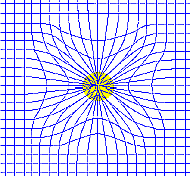
1.5d). Repeating the same procedure for the vertical
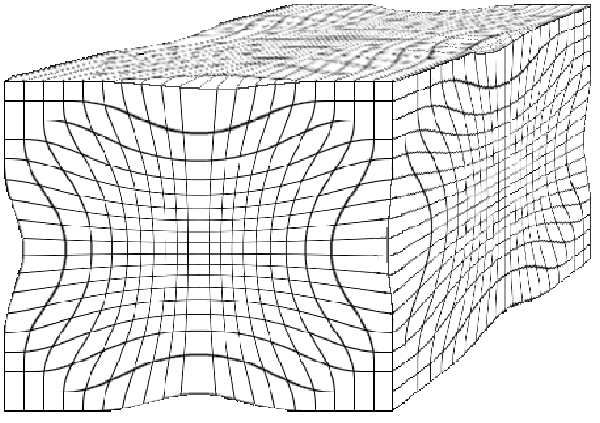
direction, the resulting model is shown in Figure 1.5e,
where, it is clearly visible, that the initial curvature
of spacetime in the original model, has changed into a
stretching inwards the mass. By repeating again the
procedure, for the third axis, perpendicular to the page,
the final three dimensions model is obtained as shown in
Figure 1.6, where the mass would be at the centre inside
the picture. Each line, represents a coordinate that gets
distorted by the mass inside, by the same mysterious
force that interacts with spacetime by curving it in the
original rubber sheet model proposed by Einstein. The
eight corners of the figure, are not distorted as they
are further away from the mass than the sides which are
instead distorted. This is because, being the mass
spherical, then the distortion caused by it, all around
it, must be spherical too. Moreover, the faces of the
cube, should also be slightly distorted inward (concave).
as their plane is not distant enough from the mass to not
suffer any distortion.
|
 |
(a)
 |
(b)
 |
(c)
 |
(d)
 |
(e)
Figure 1.5 - (a) One dimensional spacetime gravity model, (b) overlap of the two equilibrium points, (c) immerse the mass into the rubber sheet by first inserting the model into a coordinate system, (d) add layers of rubber and (e) repeat for vertical direction to obtain two dimensional model for gravity.
| Figure 1.6 - Final three dimensional version of spacetime distortion around a spherical mass (left). |