1.3.3 Latticework of clocks
Events are specified by a place and a time of
happening, and in spacetime physics these are determined
by imagining a cubical latticework, with identical clocks
placed at each intersection (Figure 1.7). These clocks
are synchronised in light travel time, which means that
each clock indicates the time employed by light to reach
its point from another reference point. To synchronise
these clocks, an imaginary flash of light is made started
from the reference clock, which spreads out in all
directions as a sphere. Whenever this flash of light
reaches a nearby clock, it sets the time for that clock
to read, so if a clock is 10 meters away, then it will
read 10 meters of light travel time.
The previous paragraph describes how to derive, from the
two dimensional spacetime curvature, to the three
dimensional stretched model for gravity. What the model
in fact represents, is that a mass placed within the
lattice, would cause it to stretch inwards as shown in
Figure 1.5e. When a ray of light enters the gravitational
field of the mass, it will find that the clocks at each
of the encountered intersections, get more and more
distant as it approaches the mass. On the other hand, it
is universally recognised that the speed of light is
constant, therefore, the travelling beam of light cannot
accelerate to reach the next clock in time such that its
speed is measured to be constant.
Considering the drawing of Figure 1.7, if the lattice is
stretched from either sides, the space between two nodes
or clocks increases, while the two clocks will still read
the same time. A beam of light reaching the first clock
in the direction of the stretching, must arrive at the
next clock at the time indicated on the clock, without
accelerating. It does this, because space is not the only
thing that gets stretched, in fact, as the two clocks get
further apart, they will always read the same time, which
means that also the time between the two clocks gets
stretched of the same amount. Therefore, to an observer
placed between the two clocks, the speed of light will
measure the same as an observer placed somewhere else
simply because his clock will run slow. As a consequence
of this statement, time near a large mass, must run
slower on the surface than on a ship in orbit around the
mass. Ref. [1][2].
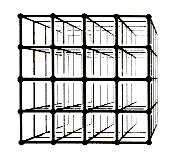 |
Figure 1.7 - Latticework used to determine events in spacetime. Each intersection between two or more sticks is represented by a clock.