1.3.4 Gravitational redshift
The previous paragraph, explained how the speed of
light stays constant whatever happens to the spacetime
medium. In this paragraph it is shown that if the
frequency of light is also assumed to be constant, then
some consistency between the gravitational redshift
formula (Equation 1.0) and spacetime arises. At the
end of the day, frequency is the rate at which the
electromagnetic field changes direction, hence, if the
speed at which the electromagnetic field travel through
space does not change, than why should the frequency. In
an antenna, the current is forced to alternate the
direction to produce changes in the electromagnetic
field, and therefore propagate through space. The
frequency at which the current alternates is determined
by the time constants within the oscillator device, which
in turn depend on spacetime. However, once the
electromagnetic wave leaves the antenna, that frequency
is held throughout the entire journey. Thus, supposing
that the frequency is constant is not a totally
unjustifiable assumption.
Figure 1.8, shows a cross section of the latticework
across the mass at the centre, and a signal coming from
outer space whose frequency is left constant throughout
the gravitational field. As spacetime in the vicinity of
large masses is stretched, than both units used to
measure time or space are also stretched, hence, either
the clock for frequency or the meter for the wavelength,
would measure a higher frequency or a shorter wavelength
respectively. Considering time for a start, and assuming
that each small square in Figure 1.8 represents one
second, from the figure it is possible to see that with
the same second two different frequencies are measured
depending how close the observer is to the mass.
 |
To look it more closely, in Figure 1.9 it is reported
one small square only, and in it, there are also two
sinwave with different frequency. This has been done to
show that for a given gravitational field, the redshift
caused by it, is proportional to the frequency as
expected by Equation 1.0. Thus, looking at the top wave
first and measuring its frequency with the bottom non
stretched second, it results 4 Hz, whilst the bottom
signal, measured with the same second results 1 Hz. Now,
repeating the measurements using the top stretched
second, as the two signals approach the mass, it is
possible to see that the top signal is now 5 Hz, whilst
the bottom is 1.25 Hz. Reassuming, the top signal was 4
Hz and has become 5 Hz, hence, Df
is 1 Hz, at the same time, the bottom signal was 1 Hz and
has become 1.25 Hz hence Df is
¼ Hz. This clearly agrees shows that the higher the
frequency the higher the shift caused on the signal in
agreement with the previous statement about Equation
1.0,
and also, again as expected, the ratio Df/f is constant for both
signals.
In order to be absolutely sure that the model agrees
completely with the formulas, a further check needs to be
done by, this time, using space instead of time. To do
this, it is simply necessary to measure the wavelength
rather than the frequency, and prove that the redshift is
also proportional to the wavelength, as:
 |
(1.3) |
which can be proved in the same way as the frequency, but substituting
the energy of the photon hf by hc/l. The fact that this time there is the final
wavelength (l2) rather than the initial (f1)
as in Equation 1.0 does not make any difference as it is simply a matter
of choosing which end is the transmitter. The positive sign means that
as the frequency increases, the wavelength decreases. So, still referring
to Figure 1.9, but considering the square to be one meter instead of one
second, the top signal wavelength, would measure 0.25 meters, and the
bottom signal 1 meter. Then, getting closer to the mass, the same meter
would stretch to become slightly longer as shown with the top double arrow
headed second. With that meter, the top signal measures 0.2 meters, and
the bottom signal measures 4/5 m or 0.8 meters. Again, for the top signal
where l was
0.25 meters, Dl=0.25-0.2=0.05m
and for the bottom signal, where l
was 1 meter, Dl=1-0.8=0.2m,
which prove that the longer the wavelength the greater the shift as expected
by the formula. Moreover, the ratio Dl/l2=0.25
is always constant and so is Dl/l1=0.2 as expected.
As it has been shown, the three dimensional latticework
model for gravity, could really be mathematically
described by the same formulas used for the gravitational
redshift with the only assumption that frequency is not
affected by gravity as for the speed.
| Figure 1.8 - Cross section of latticework of three dimensional model for gravity. |
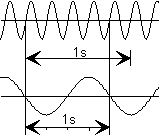 |
Figure 1.9 - One
small square of Figure 1.8, is reported to show
consistency with the gravitational redshift equation.